Why the distinction between project cost management and project financial management actually matters
Most teams treat "cost management" and "financial management" as interchangeable labels for the same activity. Both involve money, both affect project outcomes, and both generate reports used to understand how a project is performing.
The problem is that the two disciplines look at project finances from different perspectives, respond to different events, and support different decisions.
Project cost management is primarily concerned with questions such as: What have we planned to spend? What have we already committed to? What have we actually consumed? Are we still likely to complete the project within budget?
Project financial management adds another perspective: What has been invoiced? What has been recorded in the accounting system? What has been paid? What is the project's margin and cash flow?
These perspectives need to work together. A purchase order, for example, may represent a real financial commitment for a project long before the supplier invoice appears in the general ledger. Similarly, work may be completed and ready for customer invoicing before the corresponding revenue appears in accounting.
When organizations treat the accounting system as the only source of project financial information, project managers can end up looking backward. When project systems and accounting systems operate independently, finance teams may instead be left reconciling information that was never structured to work together.
The goal is therefore not simply to choose between project cost management and project financial management. It is to connect operational project information with accounting information so that both project teams and finance can work from a current and consistent financial picture.
Project cost management: definition, activities, and metrics
Project cost management is primarily a delivery-side discipline. It covers the planning, estimating, budgeting, and control of the costs required to deliver a project.
The four core activities follow a logical sequence:
- Plan cost management: Establish how costs will be estimated, tracked, approved, and reported throughout the project.
- Estimate costs: Estimate labor, materials, purchased services, travel, and other project costs using the level of detail appropriate for the project.
- Determine the budget: Aggregate estimated costs into an approved project budget or cost baseline.
- Control costs: Compare planned, committed, and actual costs, identify variances, and revise forecasts when circumstances change.
Traditional project controls may also use earned value management (EVM). Three data points drive it: Planned Value (PV), Actual Cost (AC), and Earned Value (EV).
From these, indicators such as Cost Performance Index (CPI), Schedule Performance Index (SPI), Cost Variance (CV), and Schedule Variance (SV) can be calculated.
These metrics help project managers understand whether delivery is progressing according to plan. But cost control does not have to wait for transactions to reach the accounting system.
That distinction is important.
If a project has approved a $100,000 purchase order, the project manager needs to know about that commitment immediately, even if the supplier will not invoice it for another month.
A useful project cost view therefore distinguishes between:
Planned → Committed → Actual
This provides a more forward-looking picture than accounting actuals alone.
Project financial management: more than the general ledger
Project financial management connects project delivery with the financial transactions and outcomes associated with the project.
Typical activities include:
- Customer invoicing and milestone billing
- Purchase and supplier cost tracking
- Cash flow planning and monitoring
- Revenue and margin reporting
- Accounts receivable and payment monitoring
- Capitalization where applicable
- Reconciliation with accounting data
- Portfolio-level financial reporting
Accounting remains the authoritative source for recorded transactions, tax treatment, accounts receivable and payable, and the general ledger.
But the accounting view is not necessarily the complete project management view.
A project may already have committed costs that have not yet been invoiced. Employees may have reported work that has not yet appeared as payroll cost. Materials may have been consumed from inventory before the corresponding accounting entries are available. A project milestone may have been reached and be ready for invoicing even though no customer invoice has yet been recorded.
This means that effective project financial management often requires both operational truth and accounting truth.
The project system knows what is planned, ordered, performed, consumed, and ready to invoice.
The accounting system knows what has been formally recorded, invoiced, paid, and classified.
The strongest setup connects the two.
Planned, committed, and actual: three financial views of the same project
A practical way to understand the relationship is to divide project financial information into three layers.
1. Planned
This is what the project expects to happen.
It can include:
- Planned income
- Planned labor hours and costs
- Planned material costs
- Planned purchased services
- Planned travel and other costs
- Planned payment dates
- Project- and task-level budgets
These values establish the financial plan and baseline.
2. Committed and operational actuals
This is what the project has already committed to or consumed, even if accounting has not yet caught up.
Examples include:
- Purchase orders
- Ordered materials and services
- Reported working hours
- Material consumption
- Travel
- Other operational project costs
These values are essential for forecasting because they show economic consequences before all corresponding transactions have reached the general ledger.
3. Financial actuals
These are the transactions that have been invoiced or recorded financially.
Examples include:
- Customer invoices
- Supplier invoices
- Actual payroll costs
- Inventory transactions
- Travel expenses
- Other recorded project costs
A project financial management system becomes particularly valuable when these three layers can be viewed together rather than maintained in separate spreadsheets and applications.
The two financial clocks of a project
Cost management and accounting often operate on different clocks.
Cost management reacts to operational events:
- A resource is assigned
- Work is reported
- Materials are consumed
- A purchase order is placed
- A milestone is completed
Accounting reacts to financial transaction events:
- A customer invoice is issued
- A supplier invoice is recorded
- Payroll costs are posted
- A payment is received
- An accounting period is closed
The delay between these events can be days, weeks, or even months.
Neither view is wrong. They answer different questions.
The challenge is to make both available without forcing project managers and finance teams to manually reconcile them.
Feature checklist: what should a system that covers both actually do?
When evaluating software, look beyond whether the vendor has features labeled "budgeting," "cost management," or "financial management."
A system spanning project cost and financial management should be able to support capabilities such as:
The critical question is how these capabilities work together.
Can a purchase order appear as a committed project cost before the supplier invoice arrives?
Can the eventual supplier invoice be matched with the same project and cost category?
Can actual payroll costs, material consumption, travel expenses, and other accounting data flow back to the project?
Can a customer invoice be generated from the project and immediately become visible in the project's financial view?
And can this happen without someone maintaining a parallel spreadsheet?
Starbrix Core and Starbrix Flex: an important distinction
Starbrix Core and Starbrix Flex address different levels of this problem.
Starbrix Core focuses on project delivery: planning projects and tasks, scheduling work, tracking progress and time, collaboration, and portfolio visibility.
Starbrix Flex extends project management into operational and financial project control.
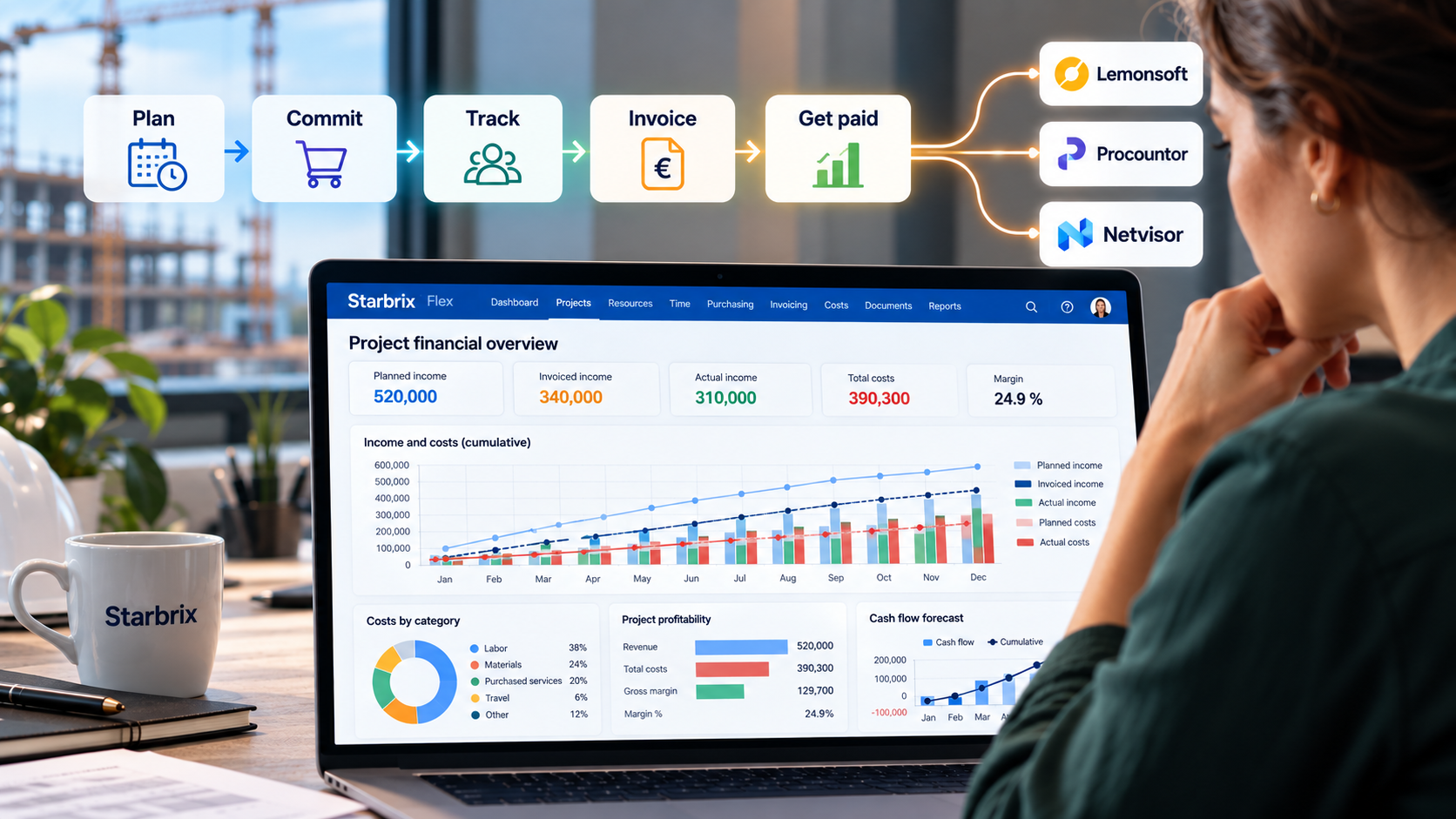
In Starbrix Flex, project teams can plan income and costs, create project- and task-level budgets, track hours, materials and purchased services, create purchase orders, follow committed costs, manage invoicing, and compare planned, committed, and actual financial values.
This means that Starbrix Flex is not simply a delivery platform that sends project information downstream to finance.
It can act as the project-centric financial control layer between operational project management and the organization's accounting or ERP system.
Connecting Starbrix Flex to accounting systems
Starbrix Flex can be integrated with accounting and ERP systems such as Fennoa, Lemonsoft, Procountor, and Netvisor.
The integration can bring financial and operational actuals into the project environment, including information such as:
- Sales orders
- Customer invoices
- Supplier invoices
- Actual payroll costs
- Inventory withdrawals
- Travel expenses
- Other project-related accounting transactions
This allows the project financial view in Starbrix Flex to combine information originating in different parts of the organization.
For example, the project may contain a planned material cost. A purchase order can then be created and shown as an ordered or committed cost. When the supplier invoice is later recorded in the accounting system, the actual cost can flow back into Starbrix.
The progression becomes:
Planned → Ordered/Committed → Actual
The project manager can therefore see not only what has already appeared in accounting, but also what the organization has committed to spending.
At the same time, accounting remains the system responsible for the general ledger and formal accounting processes.
Invoicing does not always belong to finance
Responsibility for invoicing varies between organizations.
In some companies, the finance department creates and sends all customer invoices. In others, project managers or other project staff handle invoicing because they know when milestones have been reached, which work is billable, and when contractual conditions for invoicing have been fulfilled.
A project financial management system should support both organizational models rather than assume that invoicing always belongs to finance.
Starbrix Flex allows customer invoices to be created based on project information and sent through the integrated accounting system to the end customer.
This has an important project management benefit: the project can reflect what has been invoiced immediately.
The project team does not have to wait for invoices to be created separately in another system and later transferred back before the financial status of the project is updated.
Depending on how the organization divides responsibilities, project management can therefore manage the billing process while finance focuses on accounting, monitoring accounts receivable, following up on overdue payments, and handling payment reminders and collections.
In another organization, finance may perform the invoicing as well. The important point is that the system supports the organization's chosen workflow.
Who owns project financial management?
There is no universal RACI model that fits every project organization.
Project managers typically own or contribute heavily to:
- Project budgets
- Cost forecasts
- Purchase commitments
- Delivery status
- Billable milestones
- Forecast income and costs
Finance typically owns:
- The general ledger
- Accounting rules
- Accounts receivable and payable
- Payment reconciliation
- Revenue recognition where applicable
- Payment reminders and collections
- Statutory financial reporting
Invoicing may sit on either side or be shared.
Rather than forcing a fixed division of responsibilities, the project and financial systems should allow information to move through the workflow without duplicate entry.
Scenario A: scope change forces a forecast revision
A project manager is three months into a delivery when the customer requests additional functionality.
The project manager needs to understand the financial impact before accepting the change.
The existing budget, actual costs, committed purchases, and remaining work are used to revise the forecast.
Once the change is approved, planned income and costs can be updated. If the change affects the customer contract, the corresponding additional billing can later be generated when the agreed invoicing conditions are met.
The project management and accounting processes remain distinct, but they use consistent information.
Scenario B: delivery is ahead but invoicing is delayed
A project reaches a contractual milestone ahead of schedule, but customer approval is required before an invoice can be issued.
Operationally, the project is performing well.
Financially, however, the project may still have negative short-term cash flow because costs have already been incurred while the corresponding customer invoice has not yet been sent.
The project system should make both facts visible.
Once approval is received, the invoice can be created. If invoicing is initiated from the project system, the invoiced income can immediately appear in the project's financial status while the invoice itself flows through the accounting system to the customer.
Scenario C: a purchase commitment becomes an actual cost
A project team places a $250,000 order with a subcontractor.
The sequence illustrates why project cost management and accounting need to work together:
- The cost is included in the project budget.
- The purchase order creates a committed cost.
- The project forecast reflects the commitment even though no supplier invoice has arrived.
- The subcontractor performs the work.
- Supplier invoices are received and processed in the accounting system.
- The actual costs flow back into the project financial view.
- Planned, committed, and actual costs can now be compared.
- The same information contributes to project- and portfolio-level margin reporting.
The project manager did not have to wait for step five to know that the organization had committed $250,000.
And once the accounting transaction exists, it does not need to be manually re-entered into the project.
Scenario D: project-driven customer invoicing
A project reaches a milestone that allows $80,000 to be invoiced.
The project manager or another authorized user can see that the milestone has been achieved and initiate the invoice from the project.
The invoice is sent through the integrated accounting system to the customer.
As a result:
- The project immediately shows that $80,000 has been invoiced.
- The accounting system receives the transaction required for bookkeeping.
- The customer receives the invoice through the normal invoicing channel.
- Finance can monitor whether the invoice is paid.
- If payment becomes overdue, finance can handle reminders and collections.
This removes an important information delay between project delivery, invoicing, and financial reporting.
From individual projects to the complete portfolio
Project financial management becomes even more valuable when the same model extends beyond individual projects.
Starbrix Flex can aggregate financial information across projects, operational areas, and the organization's entire project portfolio.
This makes it possible to analyze planned and actual income and costs, hours, margins, and other financial measures across multiple projects.
The significance of accounting integration therefore extends beyond making one project's numbers more accurate.
When actual payroll costs, purchase invoices, material transactions, travel expenses, customer invoices, and other financial data are connected to their respective projects, management can build a consolidated financial picture across the project portfolio.
Instead of asking finance and project management to maintain separate versions of project performance, both can work from connected data while retaining their respective responsibilities.
Evaluating tools: questions for project and finance stakeholders
Before selecting project cost management or project financial management software, ask:
- Do we need to see only recorded actuals, or also planned and committed costs?
- Can purchase commitments be followed before supplier invoices arrive?
- Can actual labor, material, travel, and purchasing costs be brought automatically into projects?
- Can customer invoicing be initiated from project information?
- Does invoiced income become visible immediately in the project?
- Can project data and accounting data move in both directions?
- Can the system accommodate our own division of responsibilities between project management and finance?
- Can financial information be aggregated across all projects?
- Can we eliminate duplicate entry and spreadsheet reconciliation?
For integrations, establish which system owns each type of information and how it moves between systems.
The goal should not necessarily be to make one application perform every accounting and project management function.
A better architecture may be to let each system do what it does best while keeping the information connected.
What success looks like
A successful project financial setup gives different stakeholders the view they need without creating different versions of the truth.
Project managers can see:
What did we plan? What have we committed? What has actually happened? What have we invoiced? Where are we heading?
Finance can see:
What has been recorded? What has been paid? What remains outstanding? Are transactions correctly accounted for?
Management can see:
How are our projects and the entire project portfolio performing financially?
This is the real intersection between project cost management and project financial management.
The accounting system tells you what has been recorded.
The project system tells you what is planned, committed, and happening operationally.
Starbrix Flex brings these views together.